
Home  /  Services  /  Software Development · Custom Software Development

Custom Software Development

Software built around your exact workflows — not workflows adapted to the software.

Off-the-shelf tools force every business into the same shape. Your customers, your margins and your bottlenecks are specific to you — so your software should be. We build the systems that are missing from your stack: the ones that hold your rules, your data and your edge.

  • Designed from your real workflows, mapped before a line of code
  • Clean, documented, tested code — built to be maintained for years
  • Secure by default: prepared statements, roles, audit logging
  • You own everything: code, data, hosting and credentials
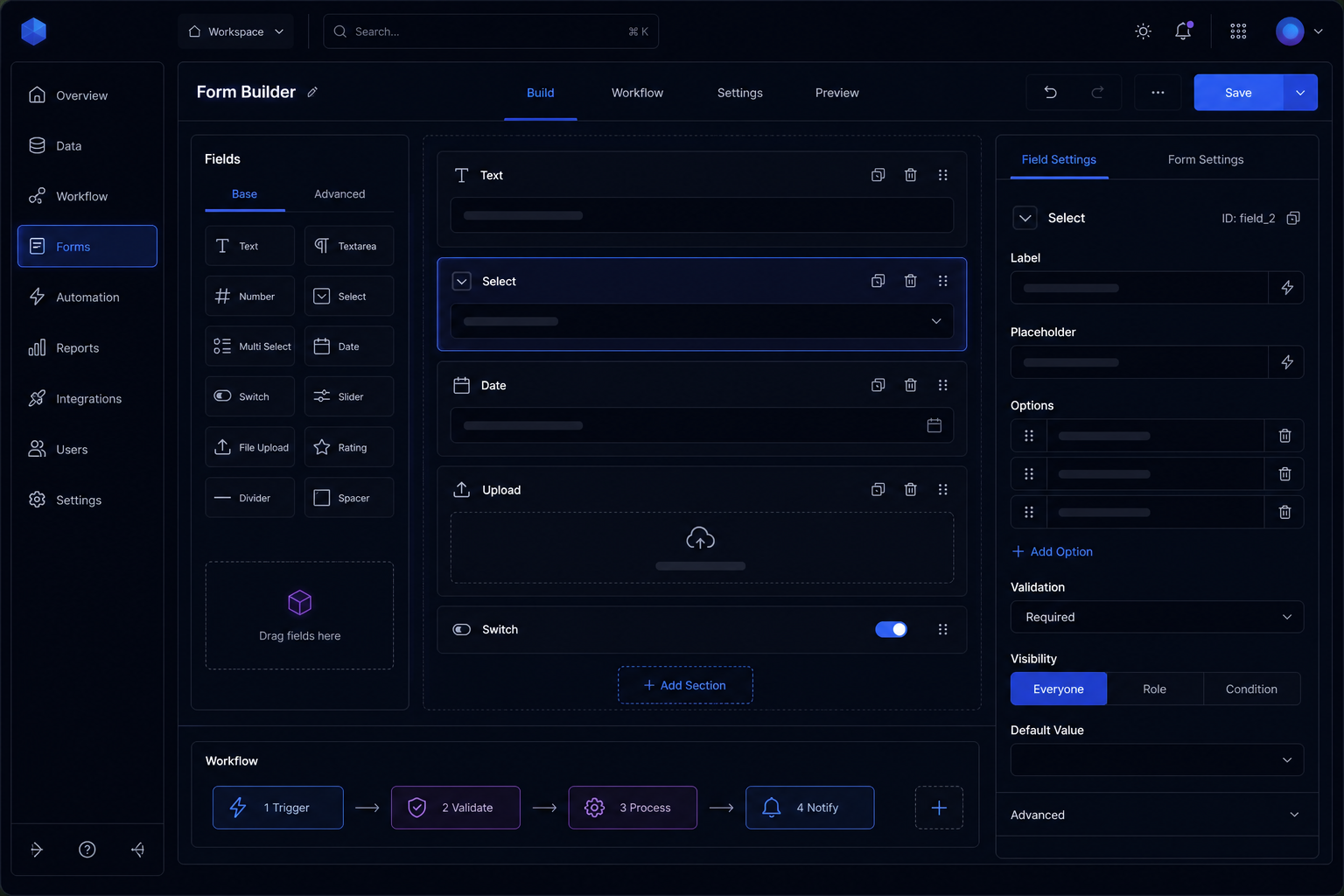
Visual representing Custom Software Development
Software Development Outcomes first
THE SERVICE SYSTEMCustom Software Development 10
Map Design Build

The problem

Software that bends the business to it.

Every generic tool is a compromise: fields you never use, steps that do not match your process, workarounds that quietly become “the way we do things.” Teams patch spreadsheets on top of the software, the software on top of the spreadsheets — and the system of record becomes a rumor.

The cost compounds. When the software does not fit the process, people work around it. Workarounds hide errors, break reporting, and turn a $500/month tool into the most expensive process in the company.

Sound familiar?

  • The tool does 80% of the job; the other 20% lives in spreadsheets
  • Every month, someone manually copies data between two systems
  • Rules and exceptions are known only to the one person who “understands it”
  • You tried reconfiguring it for six months and gave up

What we actually do

Four disciplines, one codebase.

The workstreams every custom build runs on:

01

Product design

The right system, not more of the wrong one.

  • Workflow mapping and process interviews with the people who do the work
  • Information architecture: data models that survive five years of change
  • Interface design for daily users, not demo audiences
  • Scope discipline — the smallest system that solves the real problem

02

Engineering

Built to be maintained, not just delivered.

  • Clean architecture with clear module boundaries
  • Automated testing on the paths your business runs on
  • Prepared statements and validation at every input boundary
  • Documentation: runbooks, architecture notes, data dictionary
03

Security & operations

Boring on the outside, decisive underneath.

  • Role-based access — least privilege by default
  • Audit logging for sensitive actions
  • Backups, monitoring and a disaster-recovery runbook
  • Secure deployment on the hosting you already run
04

Integrations

The glue is the product.

  • Payment gateways, accounting and ERP systems
  • Email, SMS and notification providers
  • Hardware: barcode scanners, printers, terminals, IoT sensors
  • Third-party APIs with retries, rate handling and failure alerts

The machine

From workflow to working software.

The process that turns your specific mess into a specific, shippable system.

01

Map

We shadow the work: who does what, where data enters, where it breaks. The workflow map is the contract.

02

Design

Screens and data models designed around that map — reviewed with your team, approved before build.

03

Build

Short iterations with working software you can click into, not slide decks of progress.

04

Integrate

Payments, accounts, email, devices and legacy systems connected through secure, documented APIs.

05

Launch

Staged rollout, training for the people who use it daily, and a rollback plan nobody hopes to use.

06

Evolve

A feedback loop built into the software itself — the workarounds people invent tell us what to build next.

You can watch the software being built the whole way. Every milestone lands in an environment you have access to.

How it works

A typical build, week by week.

Week 1–2

Discovery

Process interviews, workflow mapping, data audit. We agree on what the system must do — and what it must not do.

Week 3–4

Design

Data model and screen design, reviewed with your team on real content and real edge cases.

Week 5–10

Build

Iterative delivery: a working core first, then the edges. You see working software from week five.

Week 10–12

Integrate & test

External systems connected, end-to-end testing on production-like data, security review.

Week 12–13

Launch

Staged rollout with your team, training sessions, and the monitoring dashboard switched on.

Ongoing

Evolve

Maintenance, performance watching, and a roadmap fed by how the software is actually used.

Scope of engagement

Every deliverable, named upfront.

  • Workflow map and data model, agreed before build
  • Custom software with role-based access and audit logging
  • Automated test suite covering the core business paths
  • Integrations with payments, accounting and communications
  • Staff training and written runbooks
  • Monitoring, backups and a disaster-recovery plan
  • Full ownership: repository, credentials and data in your accounts

FAQ

Custom software, straight answers.

Start there whenever it fits. We will tell you honestly when a configured tool beats a custom build — it usually costs less. Custom earns its keep when the core of your business is the process itself: your margins, your rules, your reporting come from doing it in your own way. That is where we build.

The smallest useful system can ship in six to ten weeks; full platforms run several quarters. At discovery we give you a milestone plan with dates, and the first working version is always earlier in the plan — you are never waiting months to see anything real.

You do, from day one. The repository, the credentials, the hosting and the data are all in your accounts. We document the system and train your team. If we ever part ways, nothing is held hostage — that is a design rule, not a courtesy.

Custom software is a project, so it is scoped, not quoted off a rate card. After discovery you get a fixed milestone plan: what ships when, and the price for each milestone. No open-ended hourly surprises.

Have a system in mind — or a mess that needs one?

Tell us what slows your business down. We will come back with an honest read on whether it needs custom software, a configuration of something that exists, or neither.

Still comparing options? Ask Alia, our growth assistant — bottom-right corner. She’ll point you to the right service or blueprint, and hand you to a human when she doesn’t know.