
Home  /  Services  /  Software Development · Enterprise Software Solutions

Enterprise Software Solutions

Systems for the whole operation — multi-location, multi-team, multi-rule — built to carry the business.

When the business has locations, teams and rules that a single tool cannot hold, it needs a platform — not a collection of patches. We build the systems that carry an operation: the multi-location spine, the roles and the controls, the integrations that keep every part talking, and the documentation that means the next team can run it without archaeology.

  • Multi-location, multi-team, multi-currency — the rules encoded, not emailed
  • Security and governance built in: roles, audit trails, segregation of duties
  • Integrations at scale: the whole estate on one data spine
  • Documented and transferable: the system outlives the project
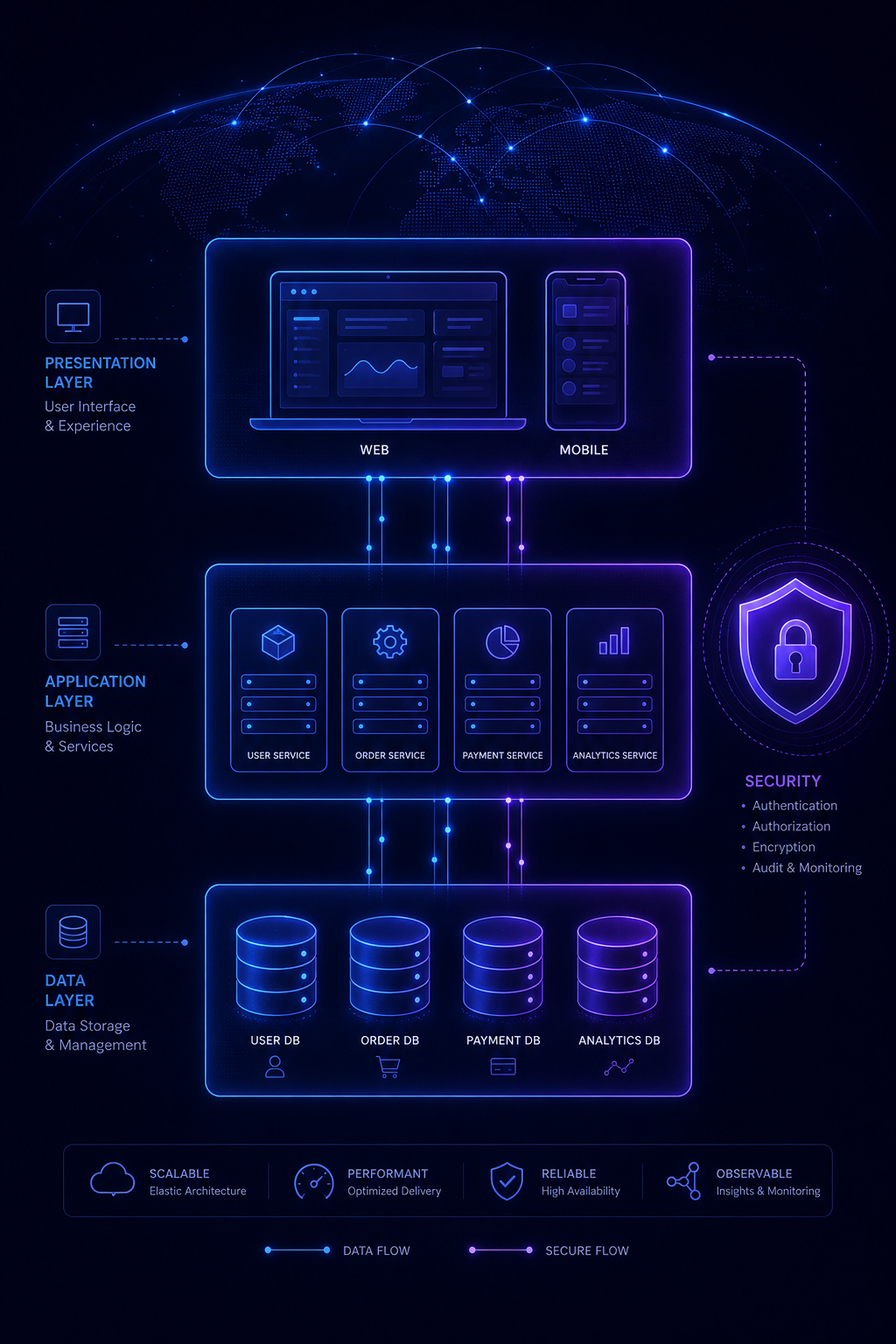
Visual representing Enterprise Software Solutions
Software Development Outcomes first
THE SERVICE SYSTEMEnterprise Software Solutions 21
Model Secure Build

The problem

The growth outgrew the tooling.

It usually starts as success: another location, another team, another market. And the tooling that worked for one does not scale to three — the pricing rules differ by location, the approval chain needs a second layer, the report that worked for one site is now a weekly reconciliation war. The business is bigger than its software, and the gap is paid in hours and in errors.

The alternative — five tools, each managing a slice — is worse: the slices do not agree, the handoffs are manual, and the “system of record” is a political question. The business needs a platform with the rules encoded, the controls in place and the data in one honest spine.

Sound familiar?

  • Each location runs “its way” — and the numbers disagree
  • Approvals need a second layer; the tool has no idea
  • The monthly close is a reconciliation across five systems
  • Knowledge lives in people, not in the system — and people move

What we actually do

The platform scope, in four blocks.

From the data spine to the board of directors:

01

Platform & data spine

One truth for the whole operation.

  • The core data model: customers, products, money, people — defined once
  • Multi-location and multi-currency as first-class citizens
  • The rules engine: pricing, approvals, policies — encoded and versioned
  • Performance engineered for the operation’s peak, not its average

02

Security & governance

The controls a serious operation needs.

  • Role-based access with least privilege and segregation of duties
  • Audit trails on every sensitive action — who, what, when, why
  • Credential and key management, encrypted channels, hardened deployment
  • Access reviews and offboarding that actually close the doors
03

Integrations at scale

The estate, on one spine.

  • Payments, accounting, logistics and the stores — connected and reconciled
  • Internal APIs with versioning, so the estate evolves without breaking
  • Batch and live flows with the monitoring to prove they move
  • Third-party and legacy systems wrapped where the API is not
04

Delivery & continuity

The system outlives the project.

  • Governed releases: tested, rolled out in stages, rolled back if needed
  • Documentation: architecture, data dictionary, runbooks, the why
  • Training for the people who run it, per layer of the business
  • A handover that means any team — including your own — can carry it

The machine

The platform, in layers.

How an operation becomes a system that carries it.

01

Model

The operation modeled: locations, teams, roles, rules and money flows — the blueprint the whole platform stands on.

02

Secure

The controls designed first: roles, permissions, segregation of duties, the audit trail — security as architecture, not a patch.

03

Build

The core platform: the data spine, the rules engine, the screens for each layer of the business — delivered in governed iterations.

04

Connect

The estate connected: payments, logistics, accounting, the stores, the sites — on one spine, with reconciliation that proves it.

05

Govern

The change loop: configuration and controlled releases, with the documentation that keeps the next change safe.

06

Scale

The growth path: the new location, the new market, the new rule — added to the platform, not bolted onto it.

Enterprise does not mean complex — it means the system has a spine. Every layer stands on the same data, the same rules and the same audit trail.

How it works

From operation to platform.

Week 1–3

Operation model

The locations, teams, rules and money flows mapped in detail — the platform blueprint, approved by the people who run the operation.

Week 4–6

Architecture & controls

The data spine, the rules engine and the security model designed and reviewed — the decisions that are expensive to get wrong later.

Week 7–16

Build

The platform delivered in governed iterations: the core first, then the layers. Each release tested, documented and shown to the teams who will live in it.

Week 16–20

Connect & reconcile

The estate connected: the integrations live, the reconciliation reports prove the flows, and the parallel run closes out.

Week 20–22

Rollout

Staged cutover by location or function, with training at each layer and the monitoring fully live.

Ongoing

Evolve

The growth loop: new locations, new markets, new rules — added to the platform under the same governance that built it.

Scope of engagement

Every deliverable, named upfront.

  • The operation model: locations, teams, rules, money flows
  • The data spine: one truth for the whole estate
  • The rules engine: pricing, approvals, policies — encoded and versioned
  • Security architecture: roles, segregation, audit, hardened deployment
  • The integrations: payments, accounting, logistics, stores — reconciled
  • Governed release process with the monitoring to prove it
  • The full documentation set and per-layer training

FAQ

Enterprise software, straight answers.

No — and a good platform project is usually a connecting project, not a replacing one. We keep what works, wrap what cannot be replaced, and build the spine the whole estate needs. Where a system genuinely should be retired, we say so with the cost of the migration on the table — the decision is yours, with the numbers.

Security is architecture, not a checklist at the end: role-based access with least privilege and segregation of duties from the design stage, audit trails on sensitive actions, encrypted channels and managed credentials, hardened deployment, and access reviews that run on a calendar. Every release passes the same security pass as the first — because release five is where most breaches start.

The set that lets a team operate the system without the project team: the architecture and why it is shaped that way, the data dictionary for every table and field, the runbooks for the operations and the incidents, the rules in writing, and the training per layer of the business. If a new hire cannot understand the system from the documents in a week, the documentation is not finished — that is the acceptance test we hold it to.

Through the same governed loop that built it: the request, the impact on the spine and the estate, the tested release, the staged rollout, the rollback plan. Configuration-level changes (a rule, a threshold, a new product) go through a faster, documented path your own team can run. The platform is built to be changed — the question is never whether it changes, but whether every change is safe and understood.

What does the operation actually run on — and where does it crack?

Tell us the scale: the locations, the teams, the systems, the rules that live in people’s heads. We will map the platform that carries it — and the gaps that are costing you today.

Still comparing options? Ask Alia, our growth assistant — bottom-right corner. She’ll point you to the right service or blueprint, and hand you to a human when she doesn’t know.