
Home  /  Services  /  Software Development · Inventory Management

Inventory Management

Stock that is true in real time — across every counter, warehouse and store, down to the last unit.

Inventory is money sitting still — and the two ways it hurts are oversell (the customer, the promise, the refund) and overstock (the cash, the shelf, the expiry). Both come from the same disease: the number in the system is not the number on the shelf. We build inventory systems that close that gap: every movement captured, every location reconciled, every reorder decision driven by your real demand.

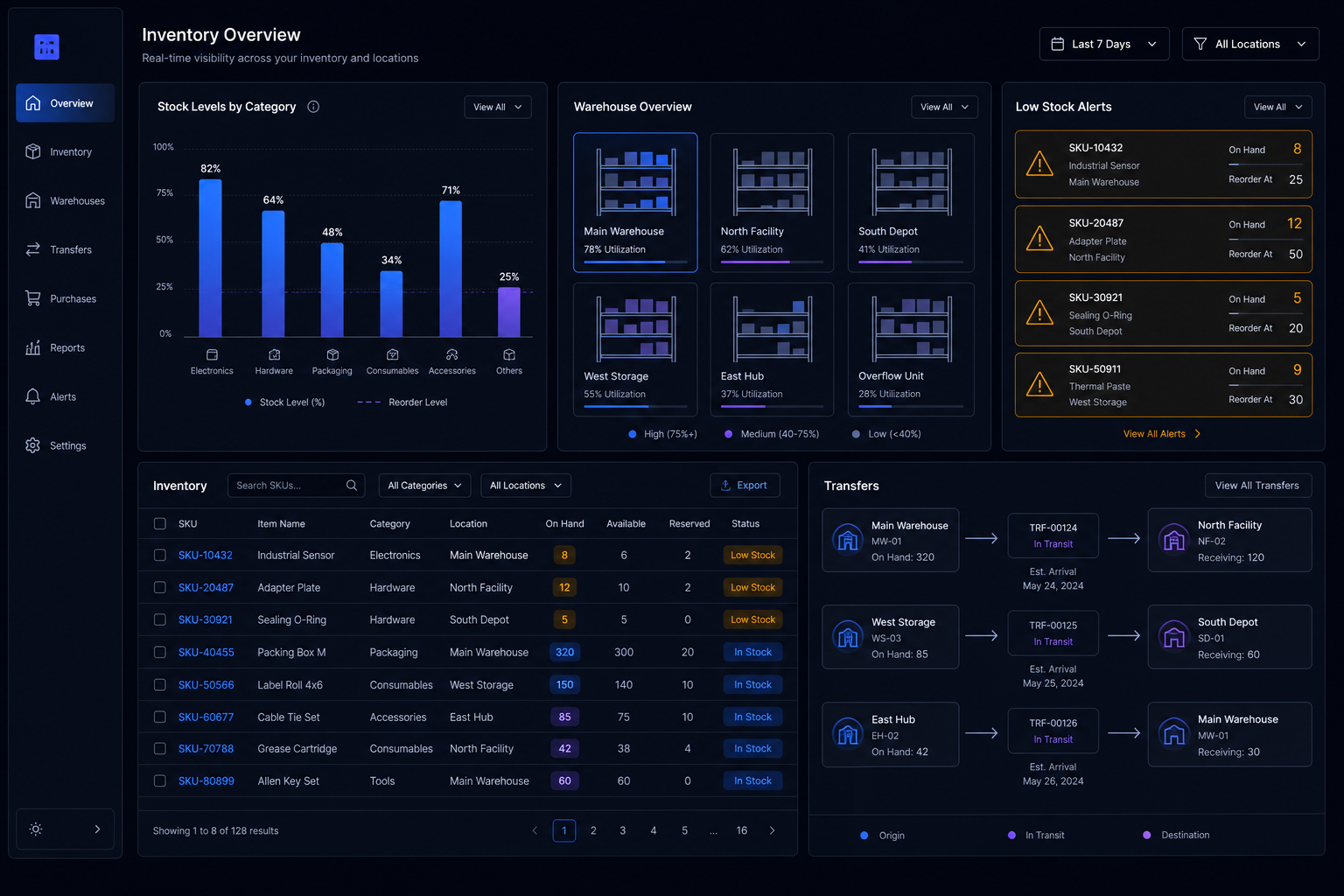
  • Real-time levels per SKU, per location — the sale, the count, the transfer
  • Reorder logic built on your demand, not a gut feeling with a spreadsheet
  • Counts that close in an evening, with variances explained, not shrugged
  • The same stock truth feeding POS, e-commerce and the dashboard
Visual representing Inventory Management
Software Development Outcomes first
THE SERVICE SYSTEMInventory Management 17
Capture Reconcile Predict

The problem

The shelf and the spreadsheet disagree.

Every business with stock knows the two failure modes: the oversell — the order takes, the item is not there, the apology goes out — and the overstock — cash in a SKU that has not moved in a quarter, while the one that sells out sits at zero. Both are the same failure: the system of record is a step behind the shelf.

Behind the symptom is distance. Sales happen at the counter, online, by phone. Stock moves between the back room, the warehouse and the store. Counts happen monthly, when they happen. Between any two of those events, nobody knows the true number — so every decision is made on the estimate.

Sound familiar?

  • “In stock” on the site, “gone” in the back room
  • The monthly count takes a team and a weekend, and still surprises you
  • Reorders arrive on instinct — and the instinct is wrong in both directions
  • You cannot say which SKUs make the money and which just sit there

What we actually do

The inventory stack, in four blocks.

The workstreams from receipt to reorder:

01

Stock truth

Every unit, accounted for.

  • SKU master with batches, expiry and location tracking where it matters
  • Barcode and QR capture: receive, pick, transfer, adjust — scanned
  • Multi-location stock with reservations and transfers
  • Adjustment and write-off workflows with reasons and approvals

02

Counting

The count that stops being a project.

  • Cycle counting: the fast-moving SKUs counted often, the rest in rotation
  • Full counts built for an evening, not a weekend
  • Variance views: what moved, who touched it, when
  • Count discipline with exception escalation
03

Buying

The reorder, de-gutted.

  • Demand-based reorder points and lead-time coverage per SKU
  • Purchase suggestion lists, PO creation and receipt matching
  • Supplier performance: fill rates, slippage, price drift
  • Dead stock and aging reports that end the silent tax
04

Integration & reporting

One stock truth, everywhere it is needed.

  • POS, e-commerce and the dashboard reading the same stock
  • Accounting integration: valuations, COGS, cost of sales
  • Inventory dashboards: value, turns, stockouts, aging — per location
  • Alerts to the right person before the shelf or the cash notices

The machine

The stock loop: capture, reconcile, decide.

The cycle we build so the number in the system is the number on the shelf.

01

Capture

Every movement recorded at the point it happens: sale, receipt, transfer, adjustment — scanned, not typed, wherever the work allows.

02

Reconcile

Counts and cycle-counts that close fast, with variances surfaced to a person with a decision to make — not averaged away.

03

Predict

Demand modeled on your history: seasonality, the slow SKU, the viral one. The reorder point is a number, not a mood.

04

Order

Purchase suggestions and PO workflows: what to buy, how much, from whom, by when — approved, tracked, received.

05

Alert

The system talks before the problem does: low stock, dead stock, expiry windows, supplier slippage.

06

Prove

The inventory valuation your accountant can sign off on, traced movement by movement.

We build on the devices your team already uses — scanners, tablets, the existing POS — so capture happens where the work happens.

How it works

From estimate to evidence.

Week 1–2

Stock audit

We profile the catalog, the locations and the movement patterns — and find where the current truth breaks.

Week 3–4

Design

The SKU model, the flows (receive, pick, transfer, count) and the reorder logic — agreed against your real demand data.

Week 5–9

Build

Capture flows, counting tools and the reorder engine, in iterations your stock team uses on the floor.

Week 9–11

Migration

Catalog and opening balances migrated and verified against a physical count — the new system starts true, not estimated.

Week 11–12

Parallel & cutover

Two weeks against the old process; variances explained line by line before the cutover.

Ongoing

Tighten

Reorder points tuned against real demand; counting discipline enforced; dead stock worked down.

Scope of engagement

Every deliverable, named upfront.

  • SKU master and multi-location stock, real-time and traceable
  • Scanned capture flows: receive, pick, transfer, adjust
  • Cycle and full counting with variance escalation
  • Demand-based reorder engine and PO workflows
  • Verified migration: catalog and opening balances counted true
  • Integrations: POS, e-commerce, accounting, dashboard
  • Inventory dashboards and the alerts that save the month

FAQ

Inventory, straight answers.

Simple catalogs often do fine on standard software, and we will recommend it when it is the cheap right answer. Custom pays when your reality is specific: multi-location with reservations, batch and expiry rules that differ per category, counting that must fit your floor, or — most often — the integration: the stock truth has to flow to your POS, your store and your accountant without a spreadsheet in the middle.

Messy is the default starting condition, and the migration plan is built around it: we profile the current data, agree the cleanup rules (duplicates, dead SKUs, unit confusion), and verify opening balances against a physical count. The system goes live with numbers you can stand behind — or it does not go live.

Usually less than you fear. Barcode scanners and tablets cover most capture; the existing POS and terminals are often reused. We spec hardware per site at discovery, and the system runs over your network with offline handling where the signal is not.

Yes, if your operations need it. Sales and movements are captured on the device and synchronized with conflict rules when the connection returns — the same design we use in POS and mobile builds. You choose which flows must be offline-proof.

Where is your money sitting — and does the system know?

Tell us your SKUs, your locations and the pain: the oversells, the dead stock, the count that takes a week. We will design the system that closes the gap.

Still comparing options? Ask Alia, our growth assistant — bottom-right corner. She’ll point you to the right service or blueprint, and hand you to a human when she doesn’t know.