Data entry
The volume, on a process.
- Manual, scanned and document data entered to your template
- Consistent formatting, coding and naming conventions
- Volume management with daily throughput reporting
- Edge cases escalated with context, not dropped

Home / Services / Bpo & Business Services · Data Entry & Data Processing
Clean, verified data — entered once, trusted everywhere, with the accuracy reported.
The data your business runs on is only as good as the last person who typed it. Garbage in the system means wrong invoices, wrong stock, wrong reports — and the quiet cost of a team working around the numbers it does not trust. We run data operations the way an operation should be run: trained operators, a verification step, and an error rate you can see.
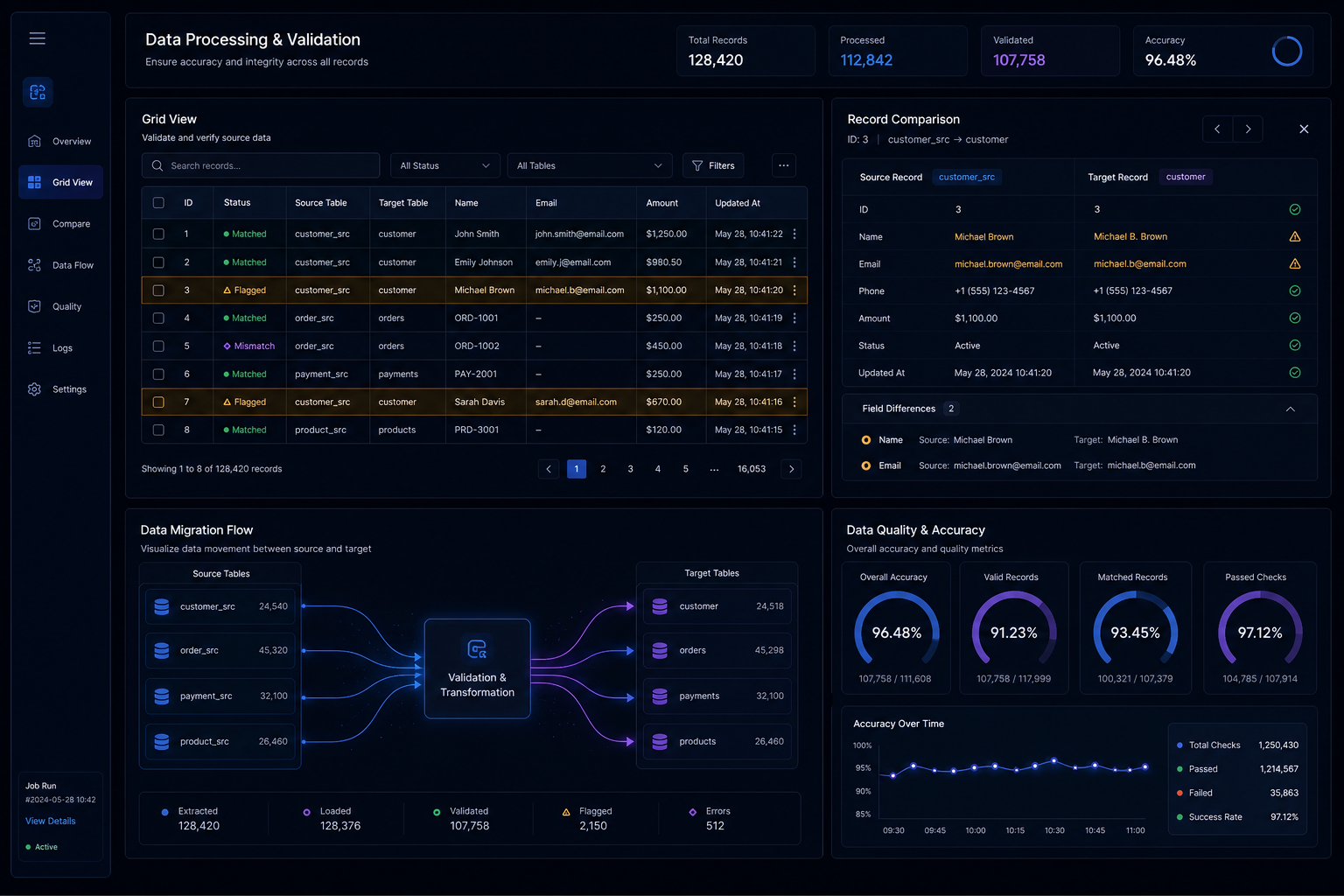
The problem
Somewhere, a spreadsheet holds the truth: the customers, the stock, the invoices, the contacts — because the official system has gaps the team fills by hand. Every manual entry is a place for a mistake, and every mistake becomes a wrong number, a duplicate, or a report nobody believes. The data work does not get less; it just gets less trusted.
Data entry feels like the lowest-value task in the business, which is exactly why it is done under pressure, without a process, and by whoever is closest. The cost shows up later, in the reconciliation, the duplicate billing and the dashboard that is “roughly right.”
Sound familiar?
What we actually do
From the raw pile to a trusted system:
The volume, on a process.
The mess, made manageable.
The move, without the loss.
The trust, kept.
The machine
A data operation with a process, a check and a number.
The field mapping, the rules and the definition of a correct record — agreed before a single row is touched.
Trained operators work the volume on a defined process, with the edge cases escalated, not guessed.
Double entry or independent sampling on every batch — the check that catches the mistake before the system does.
Cleaned, validated data lands in the destination — the sheet, the database, the CRM — with the import logged.
Throughput and accuracy per batch, the exceptions logged, and the data your team can finally trust.
The error rate is a number we report, not a hope. The accuracy target is set with you before the first batch.
How it works
We sample the data, map every field to its destination, and agree the accuracy target and the verification method in writing.
The entry process, the coding rules and the escalation path are built, and the operators are trained on your real sample.
A first batch runs end to end with full verification. You review the output and the accuracy number before the volume starts.
Steady-state processing with daily throughput, accuracy and exception reporting — the work moves, and you watch the numbers.
For ongoing work: the trickle of new data handled on the same process, keeping the system clean instead of merely filled.
Go deeper
Scope of engagement
Proof
FAQ
With a method, not a promise. The accuracy target is set with you up front, and we use the verification approach the data demands — double entry for high-stakes records, independent sampling at an agreed rate for the rest — with every batch reported against the target. When the check finds an error, it is logged, corrected and the pattern is fed back to the operators. You get the accuracy number for every batch.
Yes, by design. Data is handled under confidentiality agreements, access is limited to the operators on your project, and we follow your data-handling rules for storage and deletion. Personal data is handled in line with the rules that apply to it. At the end of the engagement, we confirm deletion or return of the working files. Your data is not an asset we keep — it is a responsibility we close.
Yours first. We enter into the spreadsheets, databases, CRMs and ERPs you already run, and we build the import templates and validation rules around them. If the destination is a manual process or a legacy system without an import, we adapt the process to it. The data lands where your business actually uses it, not in a file we control.
Priced against the work — the volume, the complexity of the source, and the level of verification — not just the rows. A pilot batch gives you the real throughput and accuracy numbers from your own data, which is what the full timeline and cost are built on. You are not quoted from an average; you are quoted from your sample.
Connected by design
Send us a sample of the data and the destination. We will scope the volume, the verification approach and the accuracy target — and tell you the timeline.
Still comparing options? Ask Alia, our growth assistant — bottom-right corner. She’ll point you to the right service or blueprint, and hand you to a human when she doesn’t know.