
Home  /  Services  /  Software Development · POS Systems — Point of Sale

POS Systems — Point of Sale

A point of sale built for your counter, your products and your money — not the other way around.

At the counter, every second and every step costs you — the queue, the double-entry, the “which price was it again?”, the till that does not balance at close. We build POS systems around your products, your pricing rules and your close-of-day reality, so the counter runs itself and the numbers arrive true.

  • Checkout engineered for speed — the common path is seconds, not screens
  • Inventory that is true at the moment of sale, across locations
  • Payments that do not fail quietly — cards, cash, wallets, refunds
  • Close-of-day that balances, reports itself and flags the exceptions
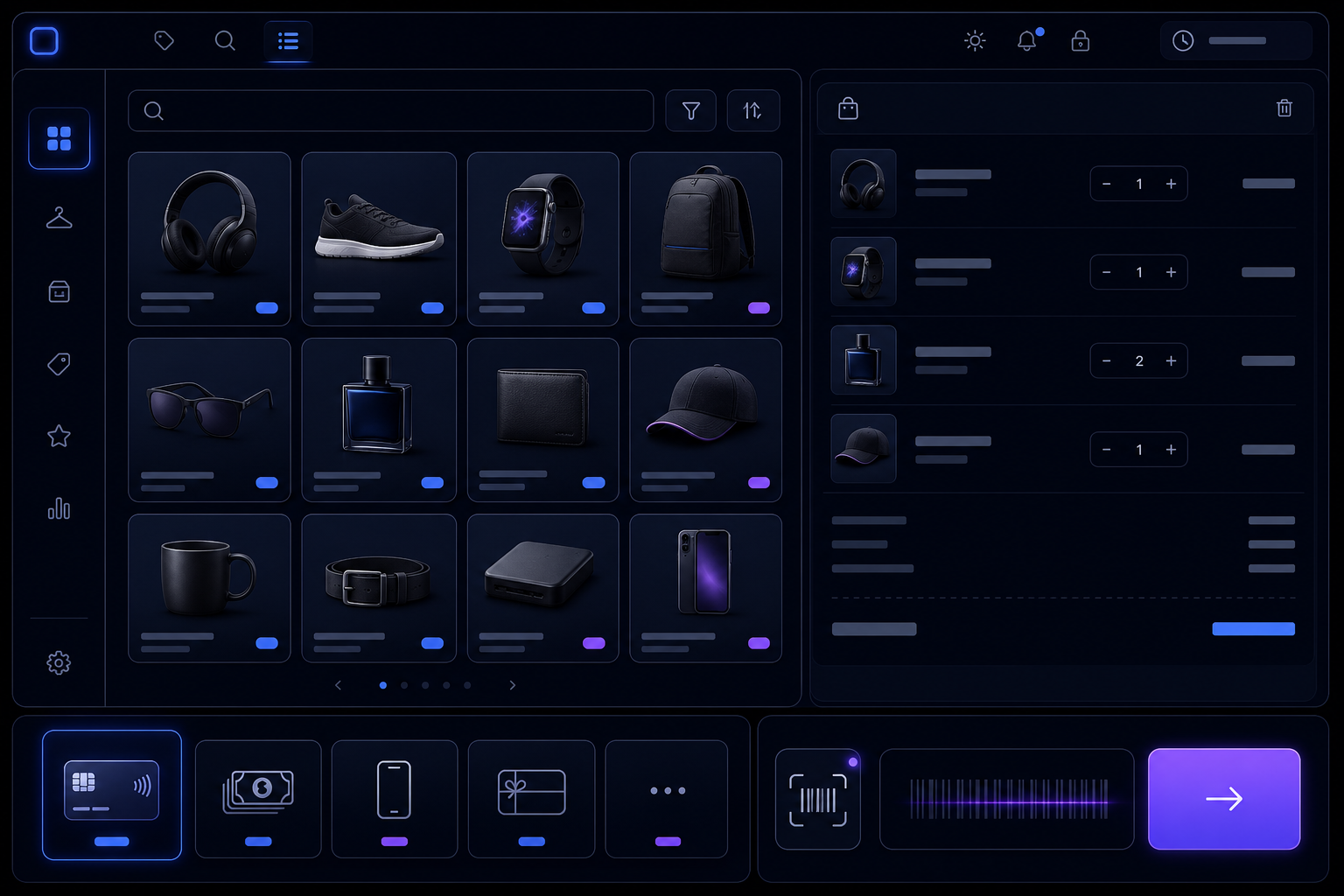
Visual representing POS Systems — Point of Sale
Software Development Outcomes first
THE SERVICE SYSTEMPOS Systems — Point of Sale 16
Sell Price Pay

The problem

The counter is a machine that leaks.

A generic POS treats your products like sample data: the pricing is “almost” right, the categories do not match the floor, the modifiers are awkward, and the end-of-day report answers questions you never asked. So the team develops workarounds — the side door, the quick discount code, the notebook — and each one is a leak in the numbers.

Leaks add up: till variances nobody can explain, stock that drifts from the back room, prices that are “probably” right, and a profit figure that depends on the person doing the arithmetic.

Sound familiar?

  • The close takes longer than it should, and never balances cleanly
  • Stock on the shelf disagrees with stock in the system
  • Specials and pricing rules live in someone’s head
  • You cannot answer “what did the counter actually earn?” quickly

What we actually do

The POS stack, in four blocks.

From the register to the board, the workstreams:

01

Counter experience

Speed is the feature.

  • Checkout flow designed around your product mix and payment mix
  • Barcode, QR and touch operation, glove-friendly and queue-tested
  • Modifiers, bundles and special pricing as first-class citizens
  • Receipts and customer comms that send themselves

02

Payments & money

No silent failures.

  • Card, cash, mobile wallet and split payments
  • Declines, partial authorizations and refunds as designed flows
  • Cash drawer accountability: opened, counted, reconciled
  • Multi-currency and tax rules done correctly, auditable
03

Inventory spine

The counter and the warehouse, one truth.

  • Real-time stock per location, decremented at the moment of sale
  • Back orders, substitutions and low-stock alerts at the register
  • Transfers, counts and adjustments through audited workflows
  • Offline mode: the sale goes through; the sync catches up
04

Reporting & control

The counter, interrogated.

  • Close-of-day reports that balance and file themselves
  • Sales by product, hour, cashier and channel — the questions you actually ask
  • Staff performance and error tracking, fair and visible
  • The same data feeding your dashboards and your accountant

The machine

The sale, end to end, without the friction.

Every step of the counter treated as a designed step — with the measurement to prove it works.

01

Sell

The common path in seconds: scan or tap, modify, pay. The screen is built for the busiest hour, not the demo.

02

Price

Your pricing rules — bundles, tiers, specials, membership — encoded, not improvised.

03

Pay

Cards, cash, wallets and splits with failure handling: a declined card is a flow, not a panic.

04

Stock

The sale decrements the right stock, at the right location, the moment it happens — even through a bad-signal hour.

05

People

Staff logins, permissions and accountability: every action tied to a person and a time.

06

Reconcile

Close-of-day that counts the till, checks the channels, flags the exceptions and files the report — in minutes.

The POS is the front door to your inventory and your revenue truth. We build it so the back office never has to argue with the counter.

How it works

From till to truth.

Week 1–2

Counter mapping

We time your busiest hour, walk the sale end to end, and write down the pricing rules, payment mix and close-of-day reality.

Week 3–4

Design

The register screens, the workflow screens and the close-of-day report — approved against your real products and real receipts.

Week 5–9

Build

Checkout, payments and the inventory spine, in iterations tested on the floor with your team — not in a lab.

Week 9–11

Integrate

Inventory, accounting, e-commerce and the dashboard connected. A test sale travels the whole machine.

Week 11–12

Parallel run

The new POS runs beside the old for a full cycle. Closes are reconciled against each other before cutover.

Ongoing

Tune

Queue times, error rates and close times tracked — the counter keeps getting faster as the rules evolve.

Scope of engagement

Every deliverable, named upfront.

  • POS register built for your product and payment mix
  • Pricing rules, modifiers and specials, encoded and testable
  • Real-time inventory per location, with offline sale mode
  • Payments, refunds and close-of-day that reconciles itself
  • Staff logins, permissions and accountability trail
  • Reporting: sales, hours, staff, variances — self-filing
  • Integration to accounting, e-commerce and your dashboards

FAQ

POS, straight answers.

For a simple shop with standard products, a bought POS is often right, and we will say so. Custom starts to pay when your pricing, your fulfillment or your close-of-day are genuinely specific — multi-location stock, complex modifiers, kitchen displays, membership tiers, or a counter that must talk to a warehouse system. The discovery map is where the decision gets made, in writing, with both costs on the table.

Designed for, not prayed over. The register works offline: sales, tenders and stock decrements are captured locally, then synchronized with conflict handling when the connection returns. You choose how much offline capability the site needs — a flagship store and a kiosk have different answers.

Usually. Android terminals, tablets, laptops, barcode scanners, receipt printers, cash drawers — we build the register for the devices you own or plan to own, and we spec the hardware for the sites where it matters (water, grease, gloves, queues).

Three ways: close-of-day reconciles the till against every channel automatically; the parallel run before cutover proves the new system against the old; and every figure in the reports is traceable to the sales, discounts and adjustments that produced it. When a number looks wrong, you can walk to the sale that made it.

What does your counter cost you every close?

Tell us your product mix, your payment mix and where the counter slows down. We will design the POS flow around it — and show you the close-of-day it produces.

Still comparing options? Ask Alia, our growth assistant — bottom-right corner. She’ll point you to the right service or blueprint, and hand you to a human when she doesn’t know.